In many valve enquiries, the first question is not always the size, the rating or the material. Very often, the real question is simpler: what does the valve actually need to do?
Does the system need to relieve excess pressure? Does it need to protect a pump? Does it need to maintain pressure upstream? Is it an overflow application? Or is the customer actually looking for a pressure reducing valve?
This distinction matters. A wrong valve selection can create installation problems, operational issues or unnecessary delays in the project.
A straight pattern pressure relief valve is normally considered when the system needs to relieve, bypass or overflow excess pressure, but the valve must be installed directly in a straight section of pipe. In other words, the function is pressure relief, but the installation requires an in-line body configuration instead of the more common angle pattern arrangement.
For compact piping layouts, marine auxiliary systems, pump bypass lines or existing installations where the pipe route is already defined, this can be a practical and efficient solution.
A quick way to understand if this is the valve you are looking for
- If pressure rises and must be discharged, you may need a pressure relief valve.
- If the valve must be installed in a straight pipe section, you may need a straight pattern relief valve.
- If the purpose is to protect a pump or auxiliary line, the application may be a bypass or overflow service.
- If the purpose is to maintain pressure before the valve, it may be an upstream pressure control or overflow application.
- If the purpose is to reduce pressure after the valve, then you are probably looking for a pressure reducing valve, not this type of valve.
- If the purpose is certified protection of a pressure vessel or critical equipment, the application should be reviewed as a safety valve / PSV duty.
What is a straight pattern pressure relief valve?
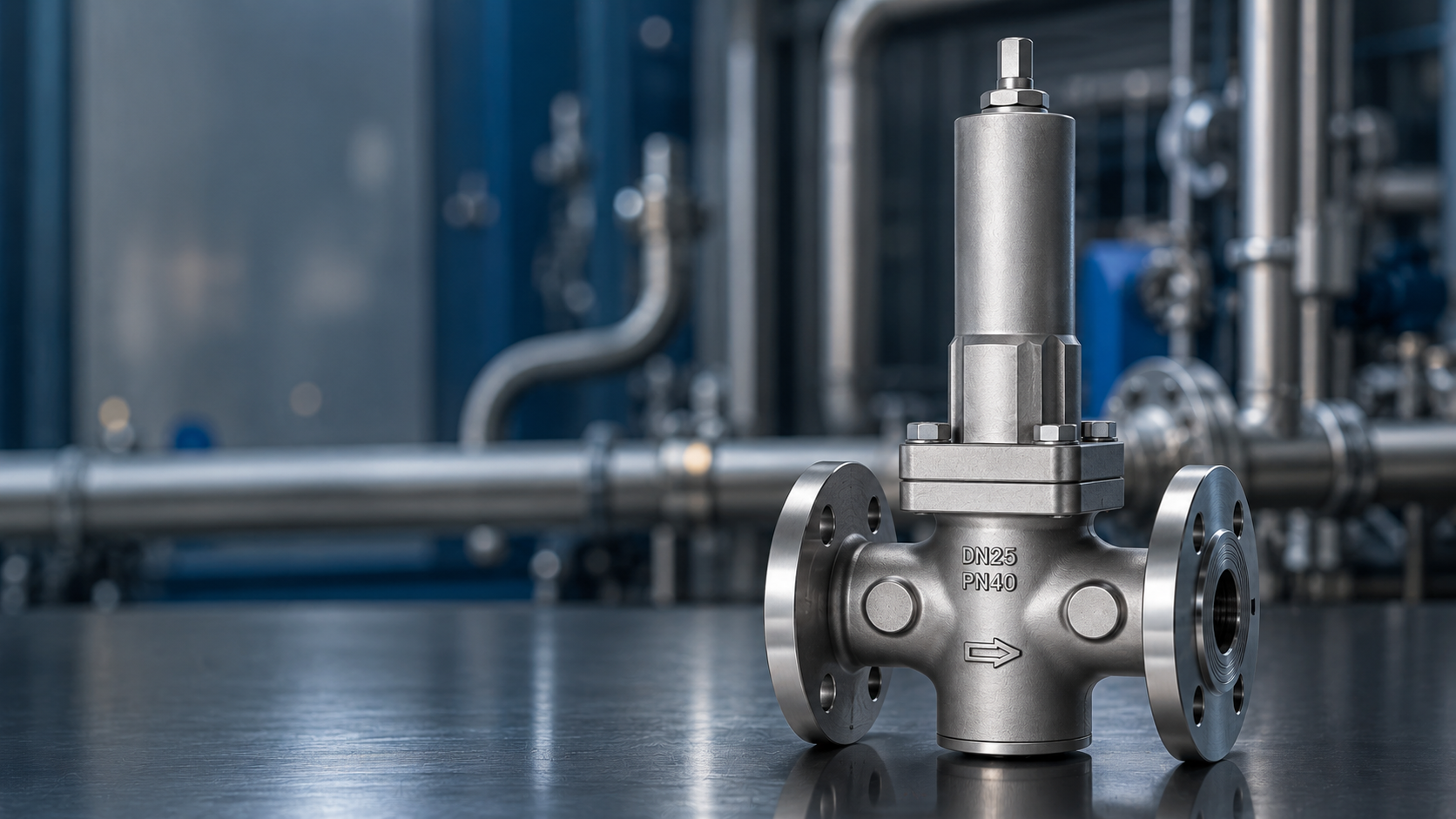
A straight pattern pressure relief valve is a pressure relief valve designed for installation directly in line with the pipe.
Unlike an angle pattern valve, where the inlet and outlet are normally arranged at 90 degrees, a straight pattern valve keeps a more direct body configuration. This can be useful when there is no space for an angular valve, when the existing piping cannot be modified easily, or when the valve is part of a compact skid, auxiliary system or replacement enquiry.
When the system pressure reaches the required set value, the valve opens to discharge or bypass the excess pressure. Depending on the installation, this may help protect a line, maintain upstream pressure, avoid overpressure in a pump discharge or provide an overflow function.
The principle may sound simple, but the correct selection depends on understanding the real service conditions.
Why straight pattern instead of angle pattern?
Angle pattern relief valves are common and often very practical. In many installations, the 90-degree body configuration works perfectly, especially when the piping has been designed around it.
But not every system starts from a clean sheet. Sometimes the customer already has an existing line. Sometimes the valve must replace an old unit. Sometimes there is no room to redesign the pipework. Sometimes the application is part of a compact skid or package. Sometimes the installation is onboard or in a marine auxiliary system, where space and routing are always important.
In these cases, the question becomes very practical: can we relieve pressure without changing the pipe route? That is where a straight pattern pressure relief valve can be the right option.
Typical applications
A straight pattern pressure relief valve may be considered in several industrial and marine applications where the function is pressure relief, overflow or bypass, and the installation benefits from an in-line body design.
- Pump bypass and pump protection.
- Overflow service.
- Upstream pressure control.
- Piping overpressure relief.
- Auxiliary systems.
- Compact skids and packaged units.
- Replacement of existing in-line relief valves.
- Marine auxiliary lines.
- Seawater, freshwater, oil, air or general service lines, subject to material and operating conditions.
In marine and shipboard environments, this type of solution is often associated with compact auxiliary systems where practical installation, line routing and service compatibility are key factors.
What this valve is not
This point is important because many enquiries arrive with mixed terminology. A straight pattern pressure relief valve is not normally a pressure reducing valve.
A pressure reducing valve controls the downstream pressure. A pressure relief valve opens to release excess pressure from the system, normally acting on the upstream side, on a bypass line or on an overflow/discharge arrangement.
It should also not be automatically treated as a certified PSV for pressure vessel protection unless the design, certification and project requirements confirm that duty.
If the application involves pressure vessel protection, coded safety valve requirements, certified set pressure testing, specific standards or critical safety functions, EFSVALVES can review the case and propose the appropriate safety valve solution.
The important point is not to force the wrong product into the wrong function.
Available configurations
The straight pattern pressure relief valve can be supplied in different configurations depending on the application and project requirements.
- Sizes from DN 15 to DN 100, 1/2″ to 4″, subject to confirmation.
- Threaded or flanged connections.
- Carbon steel ASTM A216 WCB.
- Stainless steel ASTM A351 CF8M.
- Pressure ratings such as PN 25, PN 40, Class 150 and Class 300, depending on design and application.
- Industrial or marine service configurations.
- Other executions or materials upon request.
Final selection must always be checked according to the real service conditions.
What information should be provided?
A good valve selection starts with good application data. However, we know that not every enquiry arrives complete from the beginning. If you are not sure about all the details, send us the information you have. We can help identify what is missing.
- Fluid and service type: liquid, gas, air, oil, seawater, freshwater or other service.
- Operating pressure.
- Required set pressure.
- Maximum allowable pressure, if applicable.
- Flow rate to be relieved.
- Operating temperature.
- Backpressure, if any.
- Inlet and outlet connection type.
- Required valve size.
- Preferred material.
- Installation position.
- Industrial or marine application.
- Required certification.
- Applicable project specification.
- Whether the valve is intended for relief, overflow, bypass or safety protection.
This helps avoid confusion between relief valves, overflow valves, bypass valves, pressure reducing valves and safety valves.
Why EFSVALVES?
At EFSVALVES, we know that many valve enquiries are not perfectly defined at the first step.
Sometimes the customer knows the existing valve size but not the exact function. Sometimes the project specification uses unclear terminology. Sometimes the drawing shows a valve, but not enough process data. Sometimes the buyer asks for a “safety valve” when the application may actually be relief, overflow or bypass service.
Our role is to help clarify the requirement before proposing the valve. We review the application considering pressure, temperature, fluid, set pressure, flow to be relieved, connection type, material, installation layout, documentation needs and project constraints.
This approach allows us to support both small replacement enquiries and project-based requirements, with the same technical attention.
EFSVALVES combines valve knowledge, international project experience and practical support to help customers select the right configuration, not just a catalogue reference.
Need a straight pattern pressure relief valve?
If your application requires pressure relief in a straight piping layout, EFSVALVES can help you evaluate the right solution.
Send us the data you have, even if the enquiry is not fully complete. Our team can help you clarify whether the application requires a pressure relief valve, overflow valve, pump bypass valve, pressure reducing valve or certified safety valve.
EFSVALVES, technical valve solutions for industrial, marine and project-based applications.